Marantz 250 Vintage Amplifier - Late Serial + Restored
General:
The Marantz 250 is a beautiful vintage power amplifier from the 1970s. Rated at 125 watts per channel into an 8-ohm load, it has ample power to drive even demanding loudspeakers with ease. Built during HiFi's golden era, the Model 250 is well regarded for its robust construction, and fantastic sound.
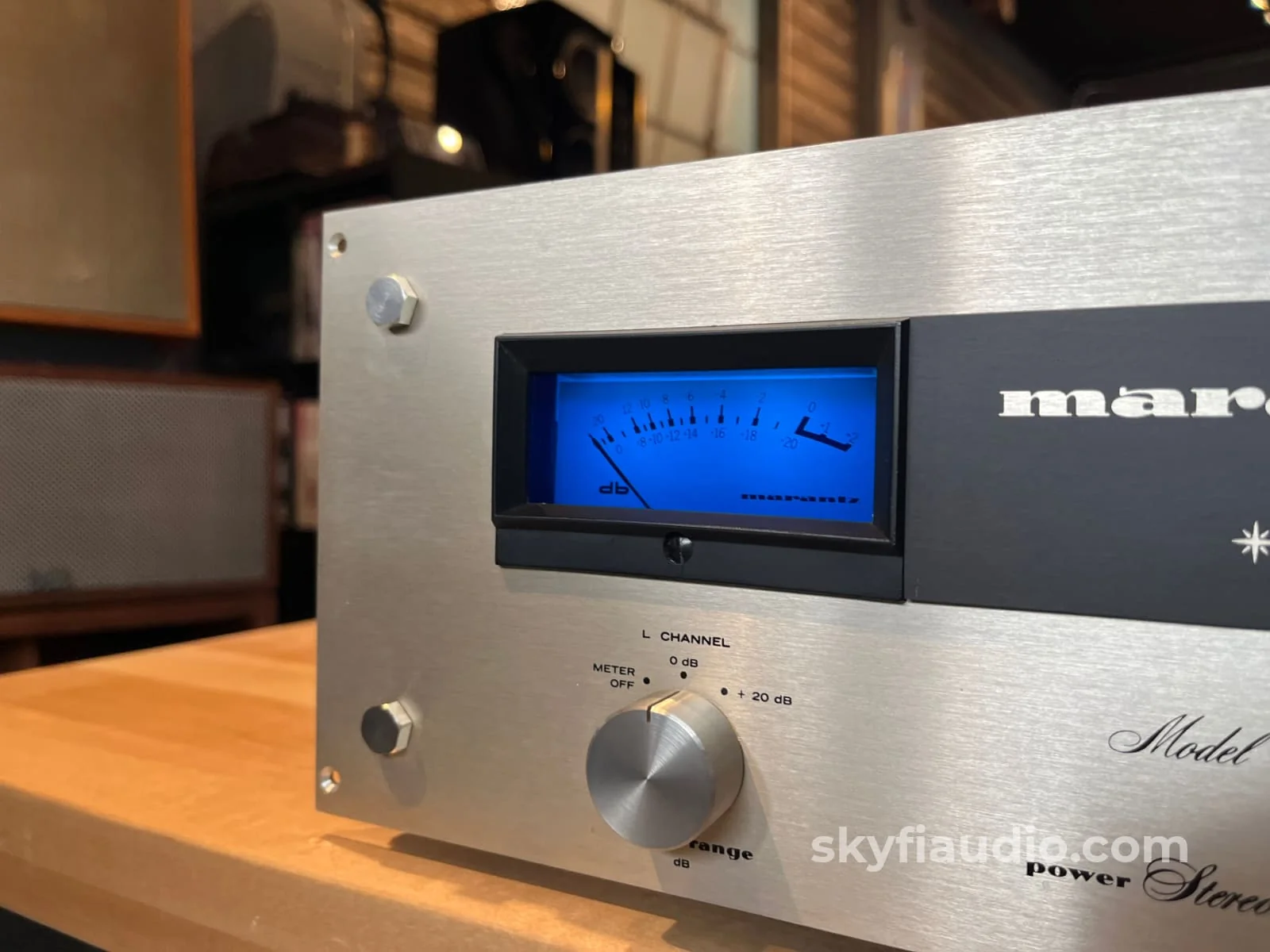
Standout features include its blue backlit power meters and iconic brushed silver faceplate. Large external heatsinks flank both sides of the amplifier, providing generous cooling for the output transistors while giving the amplifier a cool industrial appearance.
Internally, the Marantz 250 features a substantial power supply with high quality parts throughout. Whether paired with vintage or modern speakers, it remains an impressive performer more than 50 years after its introduction.
This particular Marantz 250 has been completely overhauled in-house at SkyFi. It has been thoroughly serviced, refreshed, and tested to ensure it is performing as intended and is ready to provide many more years of reliable enjoyment. Just as everything we sell, it will come professionally packaged so it arrives safely at its new home.
SkyFi Cosmetic Notes:
Very light marks are present on the faceplate. With incandescent lamps in place the meter backlighting the meters were barely visible. We opted install natural white LEDs which give the meters a beautiful cyan color similar to McIntosh.
SkyFi Technical Notes:
This amplifier received a full overhaul in house here at SkyFi. We replaced the main filter capacitors along with all of the electrolytic and tantalum capacitors which are known to cause issues long term. The differential input transistors on the amplifier boards have been replaced with matched sets, all thermal compound refreshed, and DC offset and bias adjusted according to the service manual. The meter range controls have been cleaned and meters calibrated.
This amplifier is from the 3rd and final serial number range, featuring updates throughout - making the unit easier to service and adjust.
Ownership:
Single Owner
Connections:
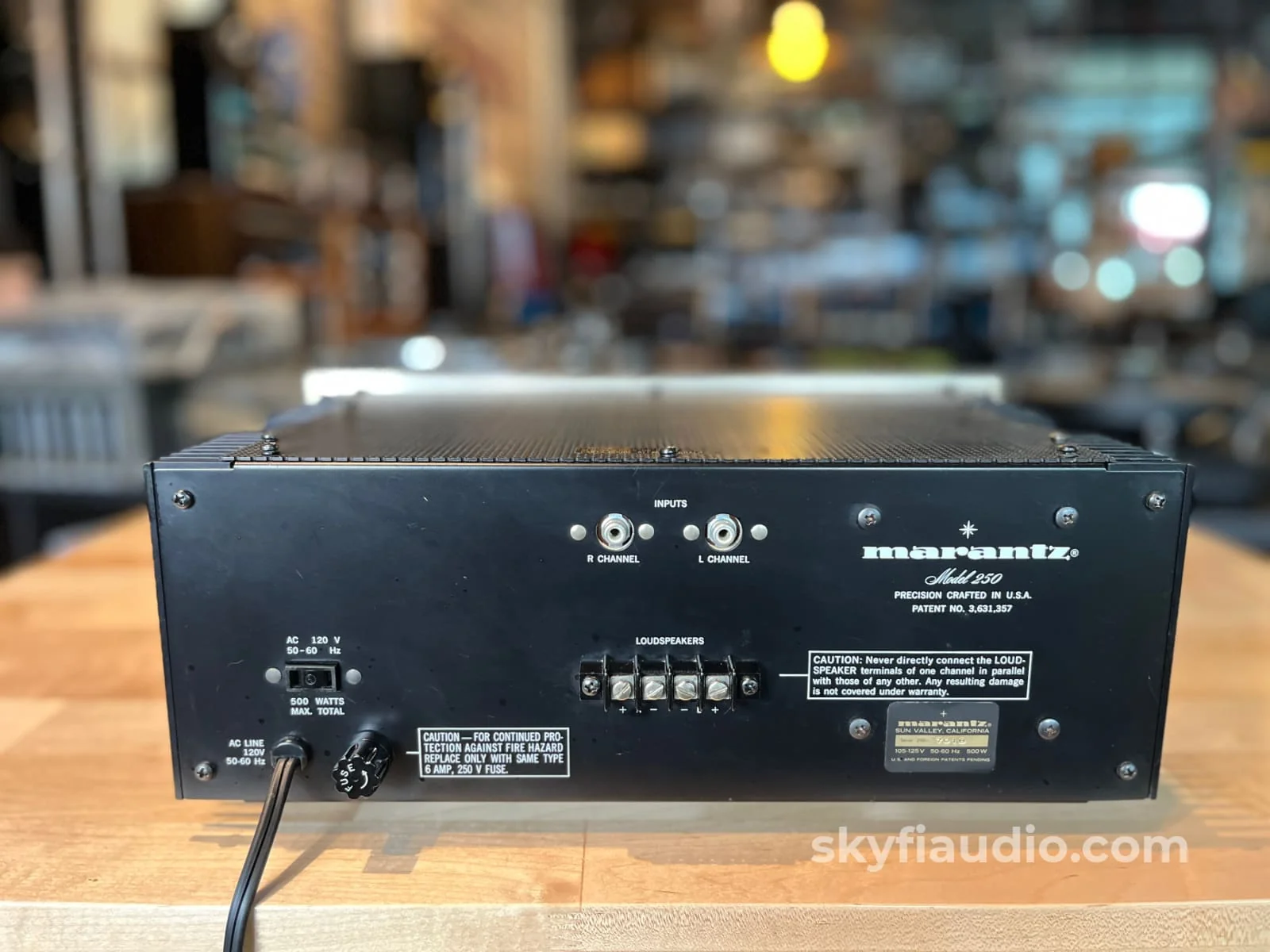
RCA, Speaker binding posts, Captive Power Cord
General Sound:
Smooth, uncolored, undistorted natural and clean
Cosmetic Condition:
8/10 = Very Good. Excellent front faceplate, one minor flaw on chassis side or top. See our detailed rating description here.
Working Condition:
Working perfectly and tested in our lab and listening room.
Included:
Just the unit and power cord.
Packing:
Will be packed using our highly developed in-house process and custom packing materials.Specs:
- Power Output: 125 watts per channel into 8Ω (stereo)
- Power Output (4Ω): 150 watts per channel into 4Ω (stereo)
- Frequency Response: 2Hz to 100kHz
- Total Harmonic Distortion: 0.1%
- Damping Factor: 100
- Input Sensitivity: 1.5V
- Signal to Noise Ratio: 106dB
Dimensions:
15-3/8 x 6-1/8 x 9-1/2 inches
Weight:
28 lbs.
Approximate Age:
1973
Link to Manual:
Click Here
Recommended Cables:
Kimber Kable - RCA Interconnects - Better
Kimber Kable - RCA Interconnects - Best
Testing Process:
We start with a visual inspection of all internal components to make sure that there are no signs of heat stress or damage. Capacitors are checked for telltale signs of predictive failure including bulging, shrunken wrappers, or physical leakage. We also inspect the PCBs for discoloration from resistors or transistors that may have been running hot. On vintage units we often spot check select capacitors for value and ESR.
If the amplifier passes visual inspection, we move on to a controlled power on sequence using a Sencore safety analyzer to monitor current draw in real time. Once the amplifier is determined to be safe to operate, we connect it to full AC mains for function and power testing. We connect the speaker outputs of the amplifier to a Sencore PA81 Power Analyzer which acts as a dummy load, DC offset monitor, and oscilloscope interface. We start with a low level 1 KHz test signal at the amplifier's input and slowly increase its amplitude while monitoring the output on an oscilloscope for signs of noise, clipping, distortion, or improper channel balance. We continue increasing the signal level until the amplifier reaches clipping.
At this point we take an output power measurement and compare it to the spec sheet of the amplifier to verify proper performance. If the device under test has both balanced and single ended inputs they are both tested at this time.
We finish off the bench evaluation with a 1 KHz square wave check and a 20 Hz to 20 KHz sine sweep to assess the amplifier's frequency response characteristics.
This battery of tests will usually reveal if the amplifier has any issues that need further attention.
Before the device leaves the bench, we perform a listening test with actual music using a variety of preferred test tracks. Our benches are outfitted with familiar monitor speakers which help us identify inconsistencies that will not always show up on our test gear. The main things that we are listening for are hum or noise with no signal present, proper center image, clicks, pops, or any other obvious undesirable audio characteristics.
If the unit passes all of these tests it is moved to our long term testing rig where we simulate real word operating conditions for 6-8 hours minimum. This allows us to monitor the unit for signs of thermal runaway or intermittent issues that only crop up when the unit has fully come up to temperature.
Product Information
Product Information
Shipping & Returns
Shipping & Returns






Marantz 250 Vintage Amplifier - Late Serial + Restored
Marantz 250 Vintage Amplifier - Late Serial + Restored
General:
The Marantz 250 is a beautiful vintage power amplifier from the 1970s. Rated at 125 watts per channel into an 8-ohm load, it has ample power to drive even demanding loudspeakers with ease. Built during HiFi's golden era, the Model 250 is well regarded for its robust construction, and fantastic sound.
Standout features include its blue backlit power meters and iconic brushed silver faceplate. Large external heatsinks flank both sides of the amplifier, providing generous cooling for the output transistors while giving the amplifier a cool industrial appearance.
Internally, the Marantz 250 features a substantial power supply with high quality parts throughout. Whether paired with vintage or modern speakers, it remains an impressive performer more than 50 years after its introduction.
This particular Marantz 250 has been completely overhauled in-house at SkyFi. It has been thoroughly serviced, refreshed, and tested to ensure it is performing as intended and is ready to provide many more years of reliable enjoyment. Just as everything we sell, it will come professionally packaged so it arrives safely at its new home.
SkyFi Cosmetic Notes:
Very light marks are present on the faceplate. With incandescent lamps in place the meter backlighting the meters were barely visible. We opted install natural white LEDs which give the meters a beautiful cyan color similar to McIntosh.
SkyFi Technical Notes:
This amplifier received a full overhaul in house here at SkyFi. We replaced the main filter capacitors along with all of the electrolytic and tantalum capacitors which are known to cause issues long term. The differential input transistors on the amplifier boards have been replaced with matched sets, all thermal compound refreshed, and DC offset and bias adjusted according to the service manual. The meter range controls have been cleaned and meters calibrated.
This amplifier is from the 3rd and final serial number range, featuring updates throughout - making the unit easier to service and adjust.
Ownership:
Single Owner
Connections:
RCA, Speaker binding posts, Captive Power Cord
General Sound:
Smooth, uncolored, undistorted natural and clean
Cosmetic Condition:
8/10 = Very Good. Excellent front faceplate, one minor flaw on chassis side or top. See our detailed rating description here.
Working Condition:
Working perfectly and tested in our lab and listening room.
Included:
Just the unit and power cord.
Packing:
Will be packed using our highly developed in-house process and custom packing materials.Specs:
- Power Output: 125 watts per channel into 8Ω (stereo)
- Power Output (4Ω): 150 watts per channel into 4Ω (stereo)
- Frequency Response: 2Hz to 100kHz
- Total Harmonic Distortion: 0.1%
- Damping Factor: 100
- Input Sensitivity: 1.5V
- Signal to Noise Ratio: 106dB
Dimensions:
15-3/8 x 6-1/8 x 9-1/2 inches
Weight:
28 lbs.
Approximate Age:
1973
Link to Manual:
Click Here
Recommended Cables:
Kimber Kable - RCA Interconnects - Better
Kimber Kable - RCA Interconnects - Best
Testing Process:
We start with a visual inspection of all internal components to make sure that there are no signs of heat stress or damage. Capacitors are checked for telltale signs of predictive failure including bulging, shrunken wrappers, or physical leakage. We also inspect the PCBs for discoloration from resistors or transistors that may have been running hot. On vintage units we often spot check select capacitors for value and ESR.
If the amplifier passes visual inspection, we move on to a controlled power on sequence using a Sencore safety analyzer to monitor current draw in real time. Once the amplifier is determined to be safe to operate, we connect it to full AC mains for function and power testing. We connect the speaker outputs of the amplifier to a Sencore PA81 Power Analyzer which acts as a dummy load, DC offset monitor, and oscilloscope interface. We start with a low level 1 KHz test signal at the amplifier's input and slowly increase its amplitude while monitoring the output on an oscilloscope for signs of noise, clipping, distortion, or improper channel balance. We continue increasing the signal level until the amplifier reaches clipping.
At this point we take an output power measurement and compare it to the spec sheet of the amplifier to verify proper performance. If the device under test has both balanced and single ended inputs they are both tested at this time.
We finish off the bench evaluation with a 1 KHz square wave check and a 20 Hz to 20 KHz sine sweep to assess the amplifier's frequency response characteristics.
This battery of tests will usually reveal if the amplifier has any issues that need further attention.
Before the device leaves the bench, we perform a listening test with actual music using a variety of preferred test tracks. Our benches are outfitted with familiar monitor speakers which help us identify inconsistencies that will not always show up on our test gear. The main things that we are listening for are hum or noise with no signal present, proper center image, clicks, pops, or any other obvious undesirable audio characteristics.
If the unit passes all of these tests it is moved to our long term testing rig where we simulate real word operating conditions for 6-8 hours minimum. This allows us to monitor the unit for signs of thermal runaway or intermittent issues that only crop up when the unit has fully come up to temperature.
Original: $2,990.00
-65%$2,990.00
$1,046.50Product Information
Product Information
Shipping & Returns
Shipping & Returns
Description
General:
The Marantz 250 is a beautiful vintage power amplifier from the 1970s. Rated at 125 watts per channel into an 8-ohm load, it has ample power to drive even demanding loudspeakers with ease. Built during HiFi's golden era, the Model 250 is well regarded for its robust construction, and fantastic sound.
Standout features include its blue backlit power meters and iconic brushed silver faceplate. Large external heatsinks flank both sides of the amplifier, providing generous cooling for the output transistors while giving the amplifier a cool industrial appearance.
Internally, the Marantz 250 features a substantial power supply with high quality parts throughout. Whether paired with vintage or modern speakers, it remains an impressive performer more than 50 years after its introduction.
This particular Marantz 250 has been completely overhauled in-house at SkyFi. It has been thoroughly serviced, refreshed, and tested to ensure it is performing as intended and is ready to provide many more years of reliable enjoyment. Just as everything we sell, it will come professionally packaged so it arrives safely at its new home.
SkyFi Cosmetic Notes:
Very light marks are present on the faceplate. With incandescent lamps in place the meter backlighting the meters were barely visible. We opted install natural white LEDs which give the meters a beautiful cyan color similar to McIntosh.
SkyFi Technical Notes:
This amplifier received a full overhaul in house here at SkyFi. We replaced the main filter capacitors along with all of the electrolytic and tantalum capacitors which are known to cause issues long term. The differential input transistors on the amplifier boards have been replaced with matched sets, all thermal compound refreshed, and DC offset and bias adjusted according to the service manual. The meter range controls have been cleaned and meters calibrated.
This amplifier is from the 3rd and final serial number range, featuring updates throughout - making the unit easier to service and adjust.
Ownership:
Single Owner
Connections:
RCA, Speaker binding posts, Captive Power Cord
General Sound:
Smooth, uncolored, undistorted natural and clean
Cosmetic Condition:
8/10 = Very Good. Excellent front faceplate, one minor flaw on chassis side or top. See our detailed rating description here.
Working Condition:
Working perfectly and tested in our lab and listening room.
Included:
Just the unit and power cord.
Packing:
Will be packed using our highly developed in-house process and custom packing materials.Specs:
- Power Output: 125 watts per channel into 8Ω (stereo)
- Power Output (4Ω): 150 watts per channel into 4Ω (stereo)
- Frequency Response: 2Hz to 100kHz
- Total Harmonic Distortion: 0.1%
- Damping Factor: 100
- Input Sensitivity: 1.5V
- Signal to Noise Ratio: 106dB
Dimensions:
15-3/8 x 6-1/8 x 9-1/2 inches
Weight:
28 lbs.
Approximate Age:
1973
Link to Manual:
Click Here
Recommended Cables:
Kimber Kable - RCA Interconnects - Better
Kimber Kable - RCA Interconnects - Best
Testing Process:
We start with a visual inspection of all internal components to make sure that there are no signs of heat stress or damage. Capacitors are checked for telltale signs of predictive failure including bulging, shrunken wrappers, or physical leakage. We also inspect the PCBs for discoloration from resistors or transistors that may have been running hot. On vintage units we often spot check select capacitors for value and ESR.
If the amplifier passes visual inspection, we move on to a controlled power on sequence using a Sencore safety analyzer to monitor current draw in real time. Once the amplifier is determined to be safe to operate, we connect it to full AC mains for function and power testing. We connect the speaker outputs of the amplifier to a Sencore PA81 Power Analyzer which acts as a dummy load, DC offset monitor, and oscilloscope interface. We start with a low level 1 KHz test signal at the amplifier's input and slowly increase its amplitude while monitoring the output on an oscilloscope for signs of noise, clipping, distortion, or improper channel balance. We continue increasing the signal level until the amplifier reaches clipping.
At this point we take an output power measurement and compare it to the spec sheet of the amplifier to verify proper performance. If the device under test has both balanced and single ended inputs they are both tested at this time.
We finish off the bench evaluation with a 1 KHz square wave check and a 20 Hz to 20 KHz sine sweep to assess the amplifier's frequency response characteristics.
This battery of tests will usually reveal if the amplifier has any issues that need further attention.
Before the device leaves the bench, we perform a listening test with actual music using a variety of preferred test tracks. Our benches are outfitted with familiar monitor speakers which help us identify inconsistencies that will not always show up on our test gear. The main things that we are listening for are hum or noise with no signal present, proper center image, clicks, pops, or any other obvious undesirable audio characteristics.
If the unit passes all of these tests it is moved to our long term testing rig where we simulate real word operating conditions for 6-8 hours minimum. This allows us to monitor the unit for signs of thermal runaway or intermittent issues that only crop up when the unit has fully come up to temperature.